Cardio-ML - Cardiovascular Risk Prediction Platform
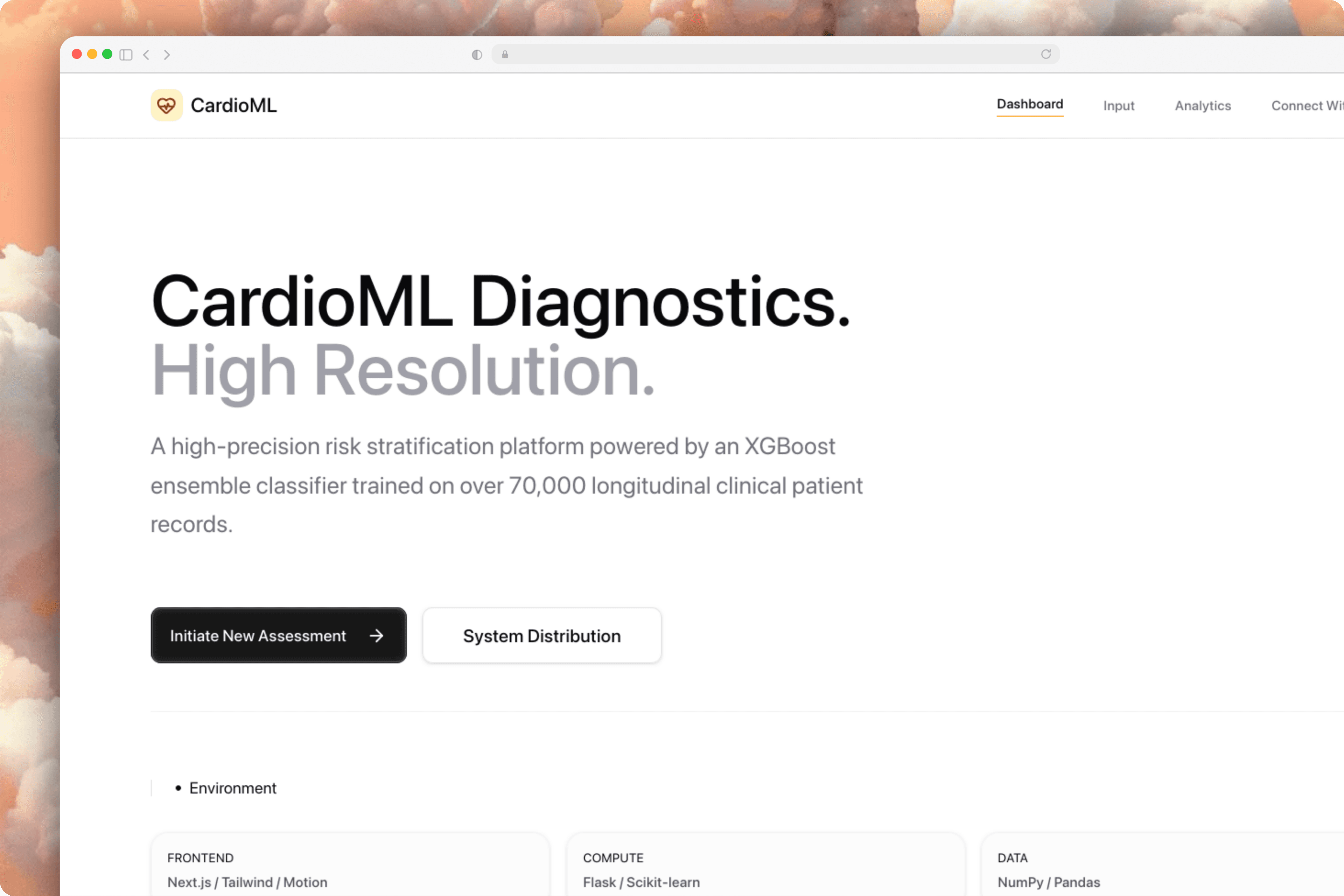
Cardio-ML is a full-stack healthcare platform that estimates cardiovascular disease risk using patient health metrics and lifestyle data. The goal was to build a machine learning model that accurately predicts cardiovascular risk using features trained with Random Forest and Logistic Regression classifiers.
How I Built This Project
Data quality is fundamental to any machine learning pipeline. The raw dataset collected from Kaggle contained over 70,000 patient records with several noisy, missing, or unstandardized fields. The initial phase focused on cleaning, feature engineering (such as deriving BMI), and preparing the dataset for model training.
Here is the raw dataset sample:
Download dataset: Cardio-ML Raw Dataset
Pandas and NumPy were used for dataset cleaning, handling outliers, and feature transformation. After preprocessing, the cleaned data was prepared for training.
Here is the preprocessed dataset sample:
Download dataset: Preprocessed Dataset
Model Training Pipeline
The machine learning workflow follows a structured pipeline using Scikit-Learn.
1. Library Imports
2. Feature & Target Selection
3. Data Splitting & Feature Scaling
4. Model Training & Evaluation
5. Performance Visualization
6. Model Serialization
Tech Stack
- Frontend: Next.js, React, Tailwind CSS, shadcn/ui, Framer Motion, Recharts
- Backend: Flask, Scikit-Learn, Pandas, NumPy
- ML Workflow: Feature preparation, model training, and serialized inference pipeline
Key Implementation Details
Handles clinical inputs such as blood pressure, cholesterol, glucose, and activity level. Applies preprocessing and derived features (including BMI) before inference. Returns both a binary prediction and a probability-based risk score for clarity.
Impact
Cardio-ML demonstrates how data science and product design can work together in healthcare contexts. Instead of exposing raw model output, the application focuses on clarity, trust, and user-friendly decision support.
Learnings
This project reinforced two critical principles:
- ML output is only useful when users can quickly understand it.
- A strict contract between UI and model API keeps iteration reliable and fast.